


Fiber-coupled semiconductor optical amplifier (SOA) in 14-pin BTF package
Semiconductor Optical Amplifiers (SOA)
The Semiconductor Optical Amplifier (SOA) is a device fabricated to amplify optical signals. The amplification is achieved by guiding the signal light through a semiconductor single-mode waveguide, serving as the gain medium. SOA chips are designed similarly to SLDs, solving similar challenges. The chip design incorporates a tilted waveguide and anti-reflection facet coating, minimizing facet reflection to less than 0.001% and reducing spectrum ripples. SOAs are engineered to amplify optical signals by up to 40dB, and certain devices offer a gain bandwidth extending up to 110nm.
Key features of Semiconductor optical amplifiers (SOA)
- High gain: Certain Innolume SOAs are engineered to amplify optical signals by up to 40dB, providing substantial gain for effective signal amplification.
- Broad-band gain: SOAs have a broad gain bandwidth, extending 110nm for some devices.
- Feedback Suppression: Tilted waveguides and anti-reflective coatings (<0.001% reflectivity) to reduce optical feedback and minimize spectrum ripples.", "Packaging Options: Different packaging options are available, ranging from 14-pin SOA modules to alternative chip placement, including on a submount or as a bare die.
- Customization: Innolume provides customization options for the SOAs, allowing adjustments to wavelength, spectrum width, and output power based on customer requests.
Typical parameters of Semiconductor Optical Amplifiers (SOA)
What are Semiconductor Optical Amplifiers?
A semiconductor optical amplifier (SOA) is a semiconductor device that amplifies input optical signals without converting input signals into the electric current. It has a similar design to laser diodes but the mirrors of the resonator are transparent. Due to broad gain bandwidth, compact size and low power consumption semiconductor optical amplifiers are an optimal choice for modern telecommunications systems. They are most commonly used in fiber optic networks, signal regeneration devices and wavelength-division multiplexing (WDM) systems.
Operating Principle of Semiconductor Optical Amplifiers
SOA chips are based on the same technology as laser diodes stimulated photon emission. The first stage of SOA operation is a carrier injection. An electric current is supplied to the amplifier's active region, exciting electrons from the valence band to the conduction band. This process creates a population inversion and more electrons occupy higher energy states, making the medium optically active. The next step is a stimulated emission. Optical signal passes through the active region and existing photons generate additional photons with the same phase and wavelength characteristics, creating thus amplification effect. This allows the signal photons to trigger additional emission, amplifying the output signal compared to the input signal.
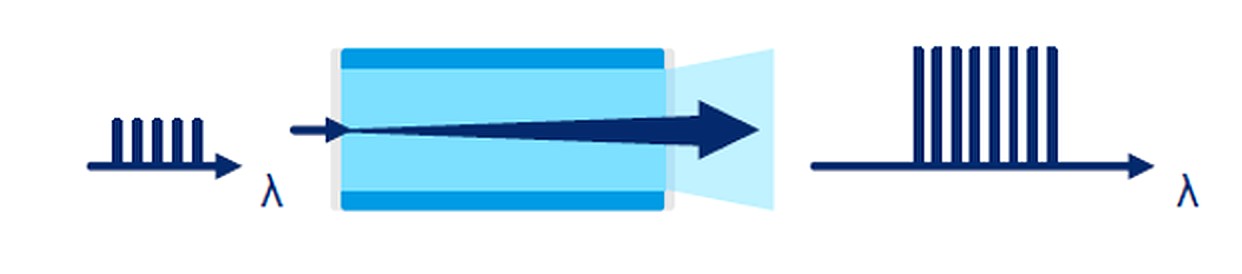
Considering the principle of operation of SOAs it is important to pay attention to the following features:
- Gain saturation. SOAs demonstrate saturation with increasing input power. The depletion of the carrier reduces the amplification effect. This nonlinear characteristic curve is useful for optical switching, wavelength conversion and signal regeneration.
- Noise and spontaneous emission. Due to the design features amplified spontaneous emission occurs in SOAs. This increases the noise level in the output signal, limiting the line capacity when transmitting data over long distances.
- Polarization sensitivity. SOAs are polarization-sensitive. Their amplification level depends on the polarization of the input signal.
Characteristics of Semiconductor Optical Amplifiers
Unique characteristics make semiconductor optical amplifiers indispensable for optical communications and signal processing systems. You can find Innolume’s SOAs for your specific request with the following parameters:
- The spectral range of amplification is from 780 to 1330 nm, which corresponds to the various industrial and research implementations.
- Gain is up to 35 dB. It shows the ratio of signal power at the output to the input. With higher gain, the weak signal is amplified more.
- The saturation output power up to 18 dBm. This level of amplification makes it possible to use SOA chips in communication lines.
- Gain bandwidth ranges from 16 to 110 nm and define the effective wavelength range with which the SOA operates.
- The noise figure is from 6.5 to 10 dB. It shows the level of signal-to-noise ratio deterioration due to internal spontaneous emission. The lower this value is, the less signal distortion will occur when transmitting over long distances.
- Polarization extinction ratio (from 15 to 18 dB) defines the change in gain depending on the polarization of the input signal. High values can lead to signal distortion or interruption in case of polarization.
- Integration capabilities. SOAs can be embedded in photonic integrated circuits (PICs) to create optical processors, WDM converters, and laser sources.
Advantages and applications of Semiconductor Optical Amplifiers
SOAs are one of the most popular types of amplifiers for optical networks, communications and sensors due to their significant advantages:
- Compact size;
- Easy integration into complex photonic circuits;
- Minimum reaction time;
- Wide spectral range;
- Low power consumption;
- Versatility — SOAs can be used as switches, wavelength converters, modulators, and logic elements.
All mentioned features of SOAs make them desirable components in the following systems:
- Short- and medium-range optical communication networks;
- Optical signal regeneration systems;
- Wavelength division multiplexers;
- Optical signal converters;
- Logical elements of networks;
- Fiber optic sensors;
- Biomedical equipment;
- LiDAR and laser rangefinders;
- Quantum communication networks;
- Cryptographic systems;
- Nonlinear optics.
Advantages of Ordering SOA Optical Amplifiers at Innolume
Innolume specializes in the design and manufacture of high-quality semiconductor components for high-speed optical communications and photonic systems. Our company uses its expertise in quantum dots and quantum wells to improve chip performance – increasing performance, reducing noise and ensuring signal stability over a wide spectral range. Innolume's SOAs can be easily integrated into standard and custom equipment due to their compact size, low power consumption and various package options.
Contact our experts to find the optimal solution for your application and learn more about the benefits of Innolume semiconductor components.