Innolume Discusses Laser Requirements for External Light Sources at PIC Summit Europe 2026

Densification is driving the next generation of optical interconnects for AI data centres. Laser sources must deliver high optical power within tighter space, energy and cooling budgets, while being manufactured in high volumes, with high yields and at low price points. Meeting these demands requires an unprecedented expansion of laser-chip production capacity. These challenges were central to Innolume’s contribution to PIC Summit Europe 2026, held on 3-4 November in Eindhoven, the Netherlands. On 4 November, Alex Borodkin, CTO of Innolume BV, presented in the session “Building EU supply chain for datacom light sources,” alongside speakers from Photon Bridge, PHIX Photonics Assembly and Demcon Photonics.
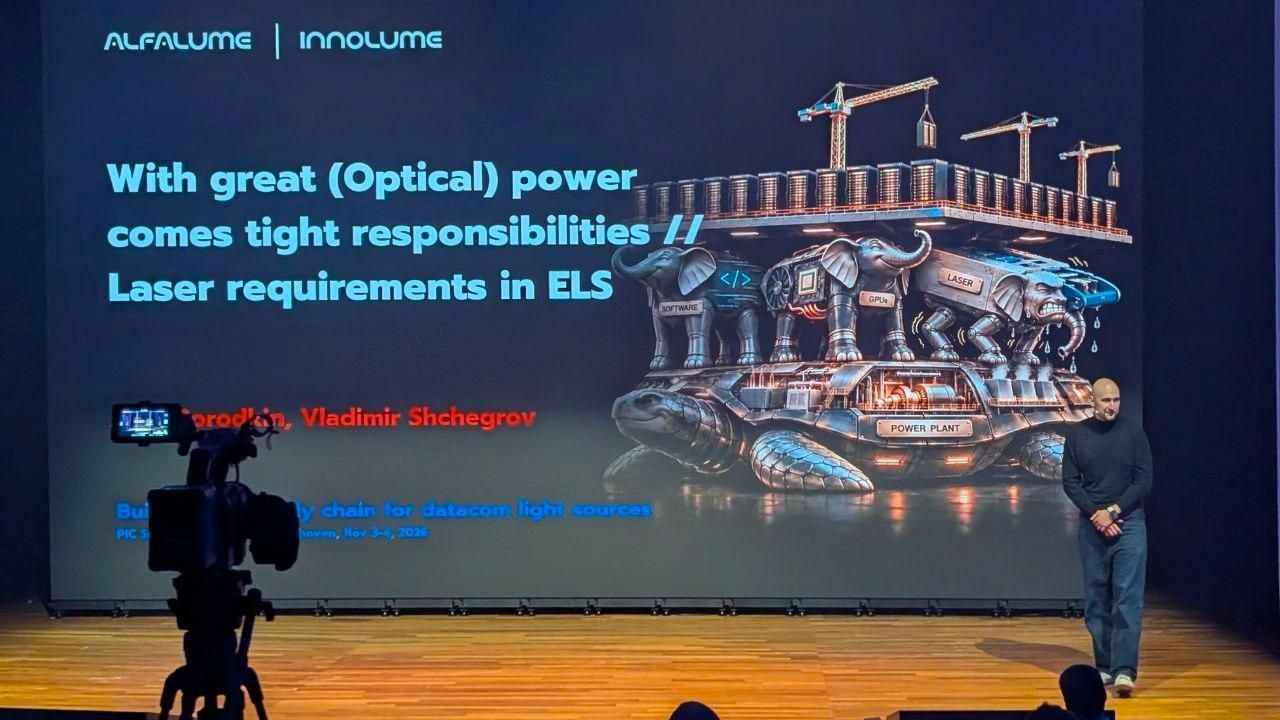
Prepared with Vladimir Shchegrov, the presentation examined what external laser sources (ELS) must deliver as optical interconnects become denser. For current single-wavelength architectures, the power requirement reaches 23 dBm, approximately 200 mW per wavelength in fibre. Innolume presented results demonstrating 400 mW output from a single-cavity quantum dot DFB laser chip without an amplifier section. Another demonstrated result was error-free operation with optical feedback up to −15 dB, addressing a major practical challenge when integrating lasers into optical systems. The talk also examined quantum dot performance at elevated temperatures and the trade-offs between DFB arrays and comb lasers for wavelength-division multiplexing.
The presentation also looked beyond the laser chip: reliable ELS modules depend on driver electronics, thermal management and packaging working together. Manufacturing scale is equally critical, with yield, testing and burn-in capacity determining how quickly strong device performance can become dependable supply. The closing message was clear: the next priorities are higher production volumes and yields, efficient operation at elevated temperatures, simpler wavelength control, fewer components and denser ELS modules. Europe already has strong photonics technology, but the presentation highlighted the absence of a European supplier delivering ELS modules in volume. That gap creates an opportunity to secure a significant role in the global AI supply chain by connecting the region’s laser, packaging, electronics and manufacturing capabilities. The challenge now is to turn that capability into industrial-scale supply quickly.
ELS development is part of the NGF2 Missions programme, supported by PhotonDelta.