
Guidelines for QD-DFB Laser Coupling in Optical Subassemblies
Introduction
Quantum-dot DFB laser diodes (QD-DFB) are continuous-wave high-power light sources attended for evaluation in 400G/800G/1.6T optical transceivers. The lasers operate in a single axial mode at 1310 nm, at a power of 50- 150 mW, and in a wide temperature range from 0 °C to 85 °C. They demonstrate about 20% power conversion efficiency without degradation at elevated temperatures, and low RIN < −150 dB/Hz. In contrast to lasers based on quantum wells, QD-DFB lasers are not so sensitive to parasitic optical feedback that allows an isolator-free assembly design. Currently, Innolume has different chip types within the portfolio, with devices providing various output power and output fields, affecting the optical coupling design. The paper aims to provide an overview and guidelines for handling QD-DFB laser beams and achieving high coupling efficiency (CE) to photonic integrated circuits (PIC) and optical fibers in optical subassemblies.
QD-DFB laser output field
The laser beam of QD-DFB laser is stigmatic, nearly Gaussian, however, elliptical (see Table 1). Table 1 contains experimental data for far-field (FF) and simulated data (which agrees with measurements) on near-field (NF) for all three chip designs and both fast (FA) and slow (SA) axes.
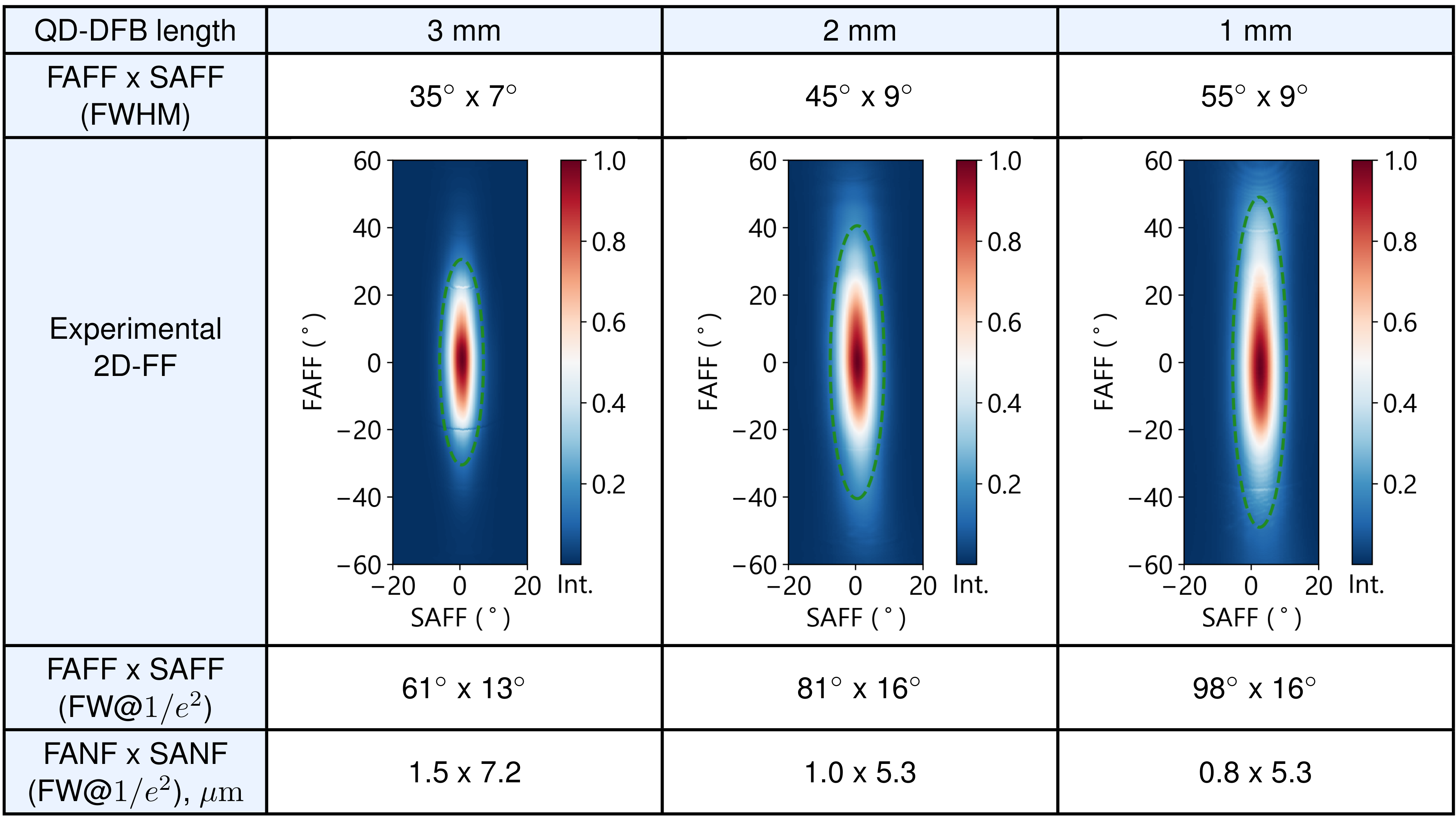
Table 1: QD-DFB output field data. The second row displays 2D far-fields measured in the experiment. The green dashed curve shows the intensity level at 1/e2.
The beam is elliptical, and the vertical divergence angle increases with decreasing chip length. Therefore, cylindrical surfaces are required for effective coupling to PICs or optical fibers designed for a round spot. To obtain high coupling efficiency, a properly designed lens set is essential.
QD-DFB Laser to PIC coupling
A set of lenses can be used to couple light from a laser into a PIC or optical fiber. At least two cylindrical surfaces with optimal sag are required to collimate an elliptical beam without introducing aberrations — one for the fast axis and one for the slow axis. For example, a combination of three commercially available glass lenses (two cylindrical- axis collimators and one circular-aperture lens) can be used. However, to reduce the number of lenses and improve coupling performance, a custom-designed set of lenses with appropriate anti-reflection (AR) coatings is required. Below, we present an example assembly scheme along with the main aspects that must be considered.
The coupling scheme with a set of two customized lenses is shown in Figure 1. To demonstrate beam modification for coupling to a circular spot, a 1 mm chip with the highest vertical divergence (55°) among the three presented was selected. In this case ellipticity (ϵ = min(x, y)/max(x, y), according to [1]) is below 0.16. The PIC mode field diameter (MFD) was set to 5 µm, matching the high-NA PM1300 fiber and falling within the typical range for silicon photonic circuits using silicon nitride edge couplers [2, 3]. The purpose of the first lens is to collimate the laser beam. The first surface should be as close as possible to the laser facet (here the distance is 150 µm), to minimize the collimated beam diameter in the vertical direction. Due to its high refractive index in the O-band, silicon is a preferred material for focusing highly divergent beams using a moderate radius of curvature. The second surface collimates the beam along the slow axis. Thus, after the first lens beam is collimated and the laser beam is closer to circular (ellipticity is 0.33). The space between the two lenses can be used to place an optical isolator if necessary. If the first lens can be placed closer than 150 µm to the laser facet, with proper surface adjustment, beam circularisation with the first lens can be even more efficient (ϵ ≥ 0.44 for 100 µm distance).
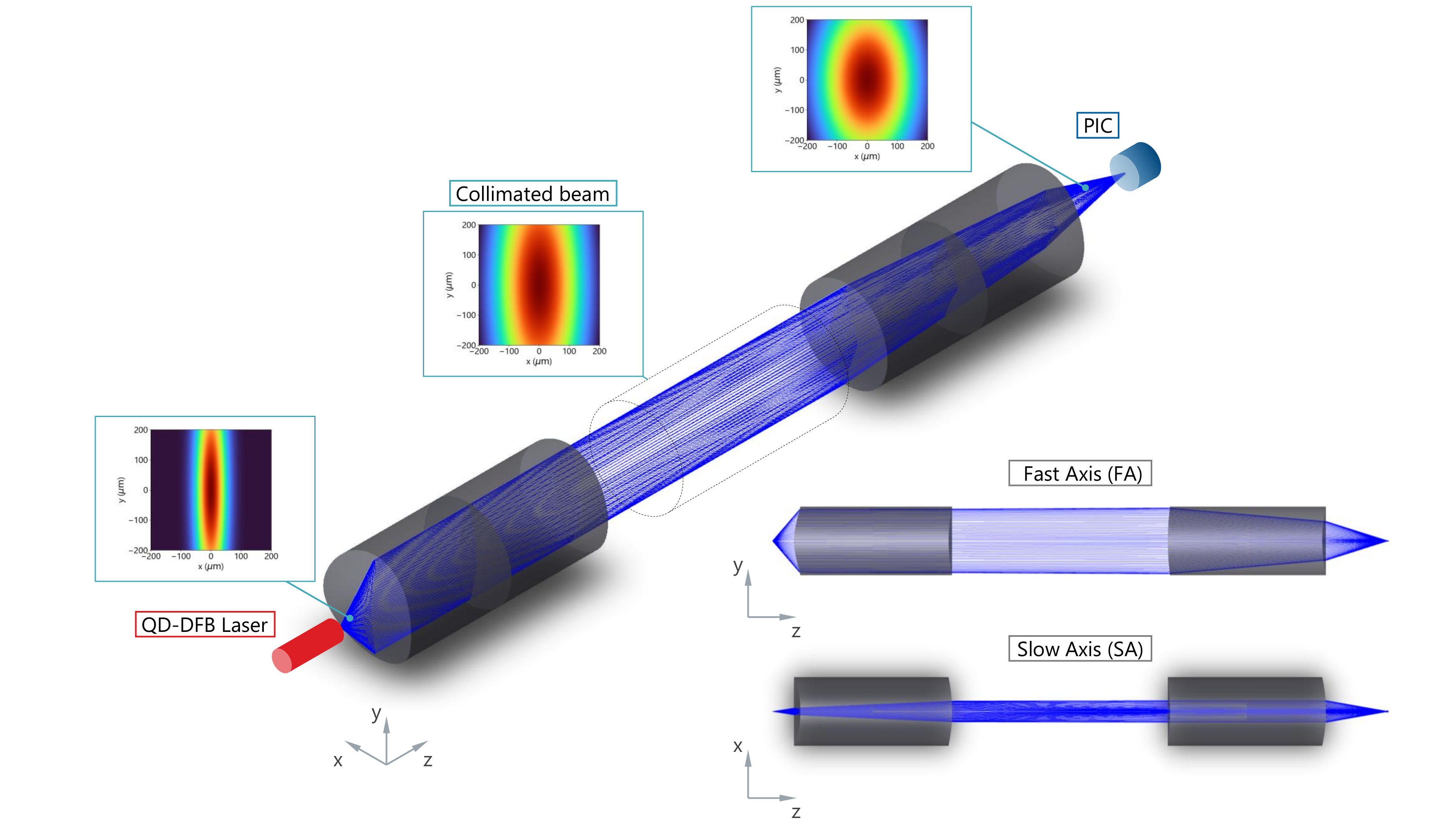
Figure 1: QD-DFB laser-to-PIC two-lens coupling scheme, illustrated for 55 x 9 degree laser divergence case. The right bottom figure shows side view planes for fast (along y-axis) and slow (along x-axis) axes. Insets along the optical path demonstrate the evolution of the laser beam.
A second lens is required to focus the collimated beam into the PIC and to further circularize the beam. In this particular case, the beam after the second lens (see inset distribution) has an ellipticity of 0.57. The model was estimated in the sequential mode of Zemax OpticStudio 19.8 and the single-mode fiber coupling feature. For simplicity, it was assumed that lenses have perfect, unperturbed surfaces and ideal AR coating. According to the model, the maximum coupling efficiency for 55 x 9 chip divergence is 83.7%. A lens set design with a shorter focal length for the first lens can yield even higher coupling efficiency in the case of the 1 mm chip.
In addition to the lens design’s maximum coupling efficiency, manufacturing precision and the sequence of lens fixation play the key role in the final subassembly performance. Coupling efficiency tolerance analysis for all three chip types and optimal lens configuration is presented in Table 2. In order to minimize misalignment caused by adhesive curing, it is important to select a low-shrinkage epoxy and carefully control both the volume and symmetrical placement of the adhesive drops. Before fixation, the lenses have to be taken by a gripper and precisely positioned with a stage having 6 degrees of freedom (6D). Active alignment and two-step fixation are necessary. In the initial step, the first lens is aligned and fixed. Lens positional tolerances are defined by the mode field diameter of the QD- DFB laser and PIC. Alignment and fixation tolerances along the fast axis are the tightest, due to the smallest mode field diameter of the QD-DFB laser in this direction (see figures in the first column in Table 2). At −1 dB coupling efficiency level, tolerances almost mimicking QD-DFB laser mode field diameter and are strongly below 1 µm along the fast axis.
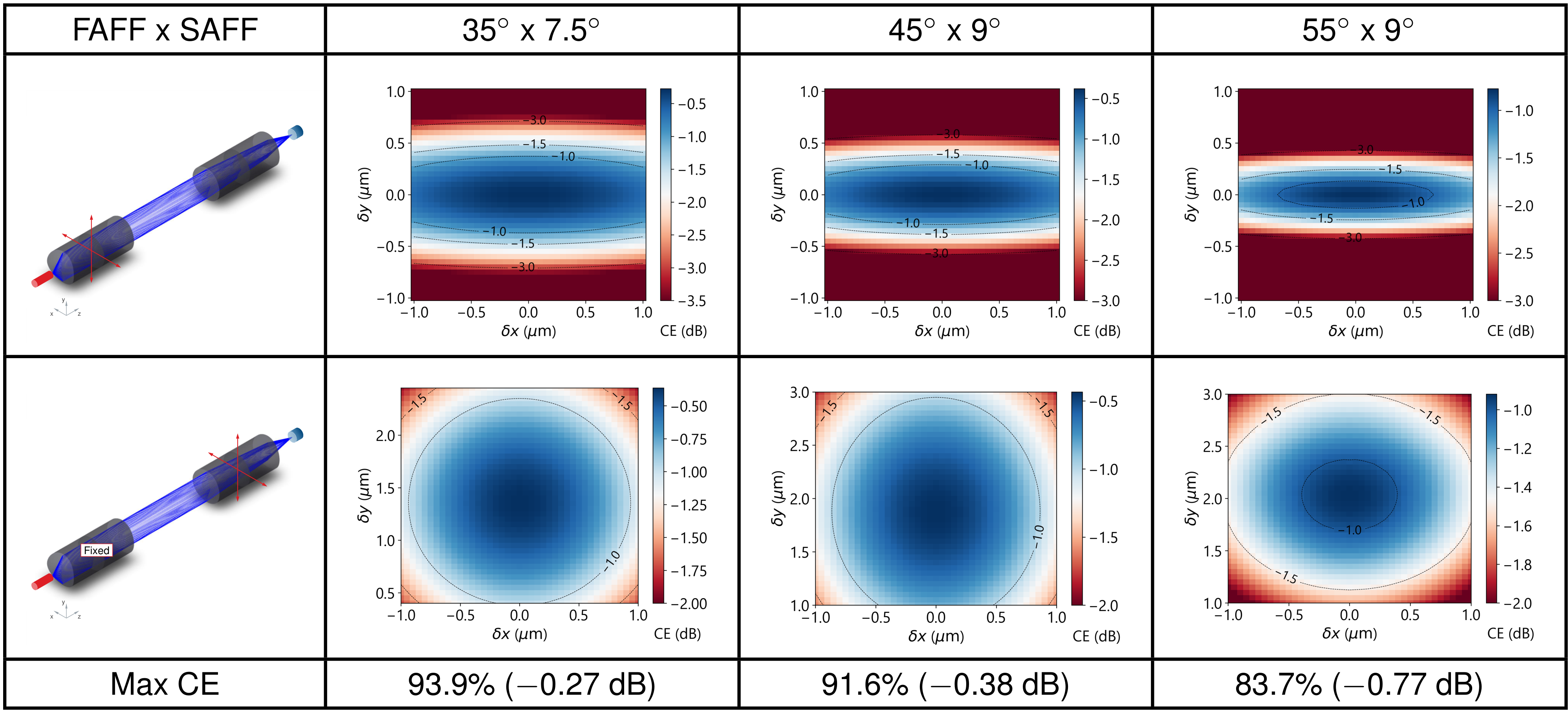
Table 2: Simulated laser-to-PIC coupling efficiency spatial positional tolerances for a first collimating lens (first col- umn). Second lens CE spatial positional tolerances assuming the first lens is misaligned by −0.5 µm from the estimated optimal position. The distance between the laser and the first lens is 150 µm in all cases.
On the second step, some deviations can be compensated by the proper positioning of the second focusing lens (see figures in the second column in Table 2). For instance, if the first lens was misplaced by −0.5 µm from the optimal position, the simulated positional tolerances for the second lens will be much more relaxed and defined by the MFD of the PIC. In the current model case, estimated tolerances for a 3-mm-long chip are ± 0.85 µm, for 2-mm-long ± 0.8 µm and for 1-mm-long ± 0.4 µm.
Conclusion
Despite the QD-DFB laser ellipticity, a properly designed custom two-lens system enables high coupling efficiency. We are happy to support our customers with design guidelines and tailored lens solutions for any specific PIC or optical fiber.
References
[1] ISO Standard 11146, “Lasers and laser-related equipment – Test methods for laser beam widths, divergence angles and beam propagation ratios”. 2005.
[2] Bishal Bhandari, Chul-Soon Im, Kyeong-Pyo Lee, Sung-Moon Kim, Min-Cheol Oh, and Sang-Shin Lee. Compact and Broadband Edge Coupler Based on Multi-Stage Silicon Nitride Tapers. IEEE Photonics Journal, 12(6):1–11, 2020.
[3] Yaqian Li, Jinbin Xu, Xueling Quan, Chenxing Guo, Xin Jin, and Xiulan Cheng. O-band and C-band dual- polarization SMF-28 edge coupler with SiON taper cladding based on silicon nitride platform. Opt. Express, 32(16):28259–28266, 2024.